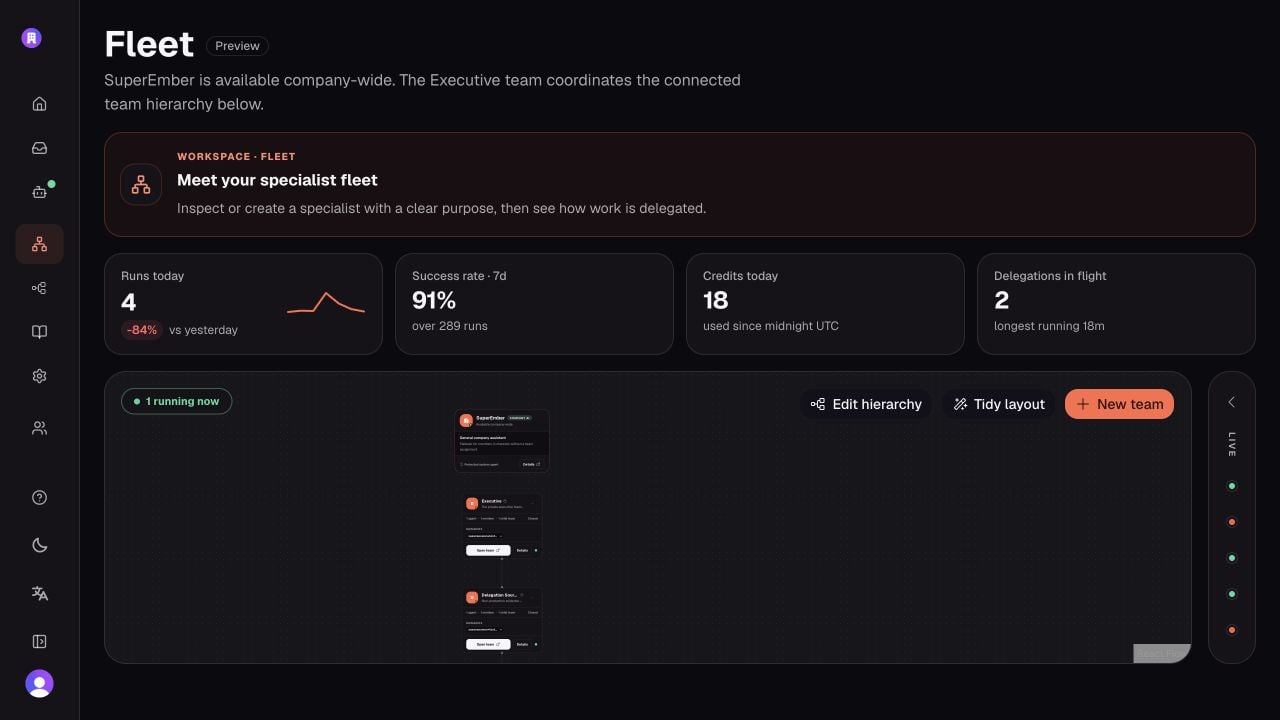
Fleet is SuperEmber’s organization chart for persistent agents. It shows protected organization identities, Team Agents, workforce specialists, team groups, reporting relationships, runtime state, and delegation activity. The Fleet surface is labeled Preview while its interaction model continues to evolve. Its stored agent identities and reporting relationships are real operational state. Fleet organization chart

What Fleet shows

  • Company AI and Executive coordination identities
  • Team groups and their Team Agents
  • Persistent workforce agents inside each team
  • parent, direct-report, and cross-team hierarchy
  • runtime and provisioning status
  • model and role metadata
  • live work and recent delegation activity

Configure a specialist

Give each workforce agent:
  1. A recognizable name and role.
  2. A purpose that explains when to delegate to it.
  3. Instructions and boundaries appropriate to the role.
  4. Only the tools and knowledge it needs.
  5. The correct parent and team.
  6. A supported model choice or the workspace default.
Draft agents cannot receive work until provisioning succeeds.

Reporting lines are operational

Moving an agent changes which manager can delegate to it. Before changing a parent, verify the destination team’s access, channels, connectors, and teamspace. Team deletion is blocked while workforce agents, child teams, or channel bindings still depend on it.

Direct delegation and workflow collaboration

Direct Fleet delegation is useful for one bounded task. Workflow collaboration nodes are better when participant selection, parallelism, join policy, cancellation, reviewer synthesis, or output schema must be explicit in run history.